Understanding life has huge implications on our development and wellbeing. The outstanding complexity of living organisms brings questions we can’t answer,
because there are strong limitations of available technologies giving sufficiently detailed insight through scattering tissues.
Amongst other activities we develop a new class of endoscopes that can break through this barrier. This technology can potentially go as far as reaching super-resolution with instruments having a footprint comparable to the dimensions of a single cell.
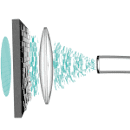
Technological boost is essential for all aspect of our research agenda. Our activities focus on imaging with new types of multimode optical fibers.
We focus mainly on gradient-index fibers, which offer low dispersion as well as high resilience to bending.
We develop new fiber terminations and end-face coatings to improve applicability in challenging conditions.
For fast and reliable image recovery we develop advanced data processing algorithms using parallel processing.
Further we focus on development of modular imaging systems and user-friendly interface that may be readily deployed in laboratories of our partners.
Lastly we develop the applications of MEMS technology for ultra-fast wavefront shaping required for methods of holographic endoscopy.
Tomáš Pikálek
tpikalek@isibrno.cz
+420 541 514 259
Miroslav Stibůrek
stiburek@isibrno.cz
+420 541 514 134

Better understanding of light-transport processes will enable faster and more precise light control especially in highly dynamic regimes of imaging. Multimode fibres deliver light signals in the form of apparently random speckled patterns, in a very similar fashion to other random media. Although multimode fibres feature remarkably faithful cylindrical symmetry they are frequently classified as unpredictable optical systems. Our research challenges this commonly held notion. We develop holographic geometries for complete and accurate analysis of light signals traveling throughout the fibre and verify the observations by advanced numerical modelling. Harnessing the predictability of multimode waveguides in endoscopy will allow for numerous enhancements of deep tissue imaging.
Tomáš Čižmár
cizmarrt@isibrno.cz
+420 541 514 131
Tomáš Tyc
tomtyc@isibrno.cz
+420 541 514 133
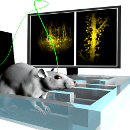
In-vivo applications represents the culmination of our efforts to introduce new imaging platform for observations inside living organisms. The methodology of holographic endoscopy utilizes light transport through standard multimode optical fibres to perform lensless minimally invasive micro-endoscopy. These possibilities represent a great promise for in-vivo bio-medical imaging, allowing an advanced methods such microscopy to be introduced into deep regions of unrestrain and awake animal models. Our current research efforts focus on allowing these methods in flexible geometries, increasing the speed of acquisition and first in-vivo experiments in animal models.
Hana Uhlířová
huhlirova@isibrno.cz
+420 541 514 340